How to Convert Korean Won: Base Rates, Bank Spreads and the Amount You Actually Pay
Read a KRW exchange-rate quote correctly, estimate a conversion in either direction, and understand why your card or bank total differs from the published base rate.
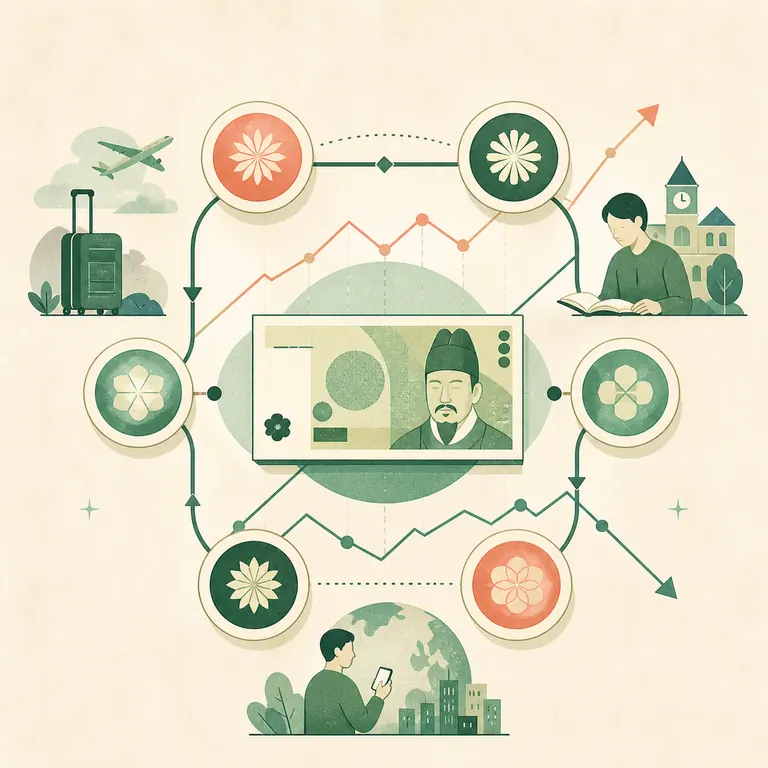
The numbers to take away
- Firessem shows how many Korean won (KRW) one unit of USD, EUR, AUD, CNH or HKD buys; Japanese yen is quoted per JPY 100.
- A base rate is a comparison benchmark, not a promise of the cash, card or wire-transfer rate a provider will apply.
- Always check the source date: Korean public data generally updates on business days, so a weekend may display the latest available weekday rate.
Start by reading the direction of the quote
All amounts in this guide state their currency explicitly. If the displayed rate is KRW 1,400 per USD 1, a USD 1,500 travel budget converts to KRW 2,100,000 before fees: 1,500 × 1,400. In the other direction, divide Korean won by the rate. KRW 3,000,000 at KRW 1,600 per EUR 1 is approximately EUR 1,875.
Japanese yen is the common exception on Korean rate tables. It is usually quoted per JPY 100, not per JPY 1. A displayed rate of KRW 930 therefore means JPY 100 costs KRW 930; JPY 100,000 is KRW 930,000 at the base rate.
Why a bank, card or airport counter gives a different total
The published base rate is the midpoint used for comparison. A bank can add a buying or selling spread, a card network can use its own settlement rate, and an ATM or transfer service can add a fixed fee. Dynamic currency conversion at a foreign checkout may add another layer by offering to charge your home currency.
For a useful comparison, calculate the base-rate amount first and then compare the provider's final amount in the receiving currency. That single number captures both the quoted spread and visible fees more clearly than a promotional 'fee-free' label.
- Travel cash: compare the amount received after the exchange discount or spread.
- Card purchase: check the network rate, issuer foreign-transaction fee and whether the merchant offers dynamic currency conversion.
- Tuition or family transfer: compare the final KRW delivered, the wire fee and any intermediary-bank deduction.
Date and currency code matter
The same amount can move meaningfully between the day you plan and the day a transaction settles. Firessem shows the rate date and whether the result came from the current public dataset or a previously verified cache. On weekends and Korean public holidays, the latest available rate may be from the preceding business day.
The Chinese yuan entry in the Korea Eximbank dataset is CNH, the offshore yuan traded outside mainland China. It should not be silently treated as onshore CNY. If a bank transfer is actually settled in CNY, use the institution's CNY quote for the final decision.
A practical checklist before sending money
Use the calculator to establish a neutral benchmark, request a final quote from the provider, and confirm which party pays any transfer charges. For a large tuition, deposit or property-related transfer, even a small percentage difference can outweigh a headline fee.
The calculator is an estimate for planning. The receipt, card statement or bank transfer confirmation remains the authoritative transaction record.
Common questions
Are the amounts in the examples U.S. dollars?
Only amounts marked USD or US$ are U.S. dollars. Every example labels USD, KRW, EUR, JPY or another currency explicitly.
Why is the Japanese yen rate shown per 100 yen?
Korean public exchange-rate tables conventionally quote JPY in units of 100 because one yen is worth only a small number of Korean won.
Can I use the result as a guaranteed bank quote?
No. It is a base-rate estimate. Your bank, card issuer, ATM or remittance service may apply a different settlement time, spread and fee.
Public data and references
More scenarios

Find Your FIRE Number
Estimate a FIRE target from annual spending, then test how long your current savings plan may take to reach it.

10 vs 20 Years of Compounding
Compare monthly investing over 10 and 20 years and see when growth begins to contribute more than new cash.

The Cost of 1% More Interest
Compare monthly payment and total interest on a 30-year loan at 3%, 4% and 5%.
Overtime & SE Tax
Compare a 45-hour workweek under the federal FLSA overtime rule with the 15.3% self-employment tax on freelance profit — two common gaps between gross pay and take-home pay.
Square Footage Isn't Universal
Convert an overseas listing's size into square feet you understand, see why a U.S. home's square footage isn't measured the way Korea's is, and learn what a commercial lease's 'load factor' actually adds to your rent.
Korea's Jeonse Conversion Rate
Learn the formula behind Korea's deposit-to-rent conversion rate, see where the legal cap does and doesn't apply, and work through a real ₩150 million deposit / ₩1.6 million rent example.
Income Percentile, Explained
Why mean and median income differ, how banded government data gets turned into a percentile rank through interpolation, and where each of the 8 countries' official income statistics come from.
Net Worth Percentile, Explained
Why every country tracks net worth by household rather than by individual, how negative net worth shows up in official data, and where each of the 6 countries' household wealth statistics come from.

Reading Growth Percentiles
A US-focused guide to measuring a school-age child consistently, interpreting WHO 2007 height and BMI percentiles, and knowing the calculator's limits.
DXA vs InBody Percentiles
Understand ALM, ALMI and SMI before comparing a DXA or InBody result with Korean, US or Chinese adult reference distributions.
2026 Federal Estate Tax Guide
Work through a US$20 million U.S. estate, the 2026 federal exclusion, deductions, portability and the unified 18%–40% transfer-tax schedule.